
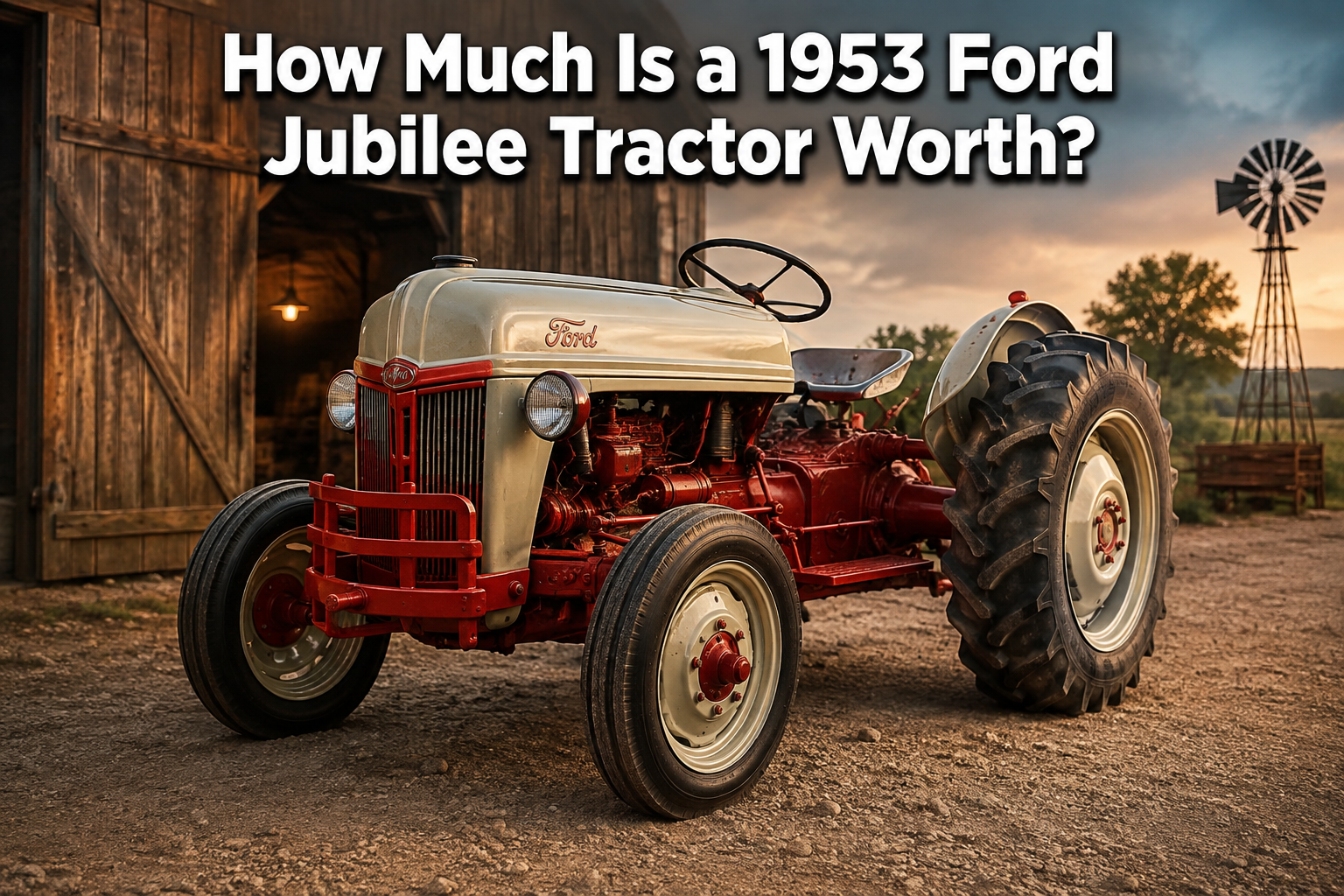
The Ford Jubilee holds a special place in tractor history because it was built specifically to mark Ford Motor Company’s fiftieth anniversary, making 1953 the only year this exact model name was used before Ford switched to calling it the NAA.
That single detail alone creates a small wave of extra interest from collectors who appreciate limited-run machinery, even though the tractor shares most of its parts with later NAA models.
For everyday buyers, though, the Jubilee is simply a dependable, mid-century workhorse that still holds up for light farm chores, mowing, and hauling.
History and Background of the 1953 Ford Jubilee
The Jubilee name has a short but meaningful history tied directly to a milestone anniversary. The section below covers where the tractor came from and why that origin still influences its value today.
The Golden Anniversary Origin
Ford introduced the Jubilee in 1953 to celebrate fifty years since the company’s founding, and the tractor was marketed as a modernized replacement for the aging 8N and 9N models.
It featured a completely redesigned engine and styling that made it feel noticeably more advanced than its predecessors. This anniversary branding is part of why some sellers list it as the “Golden Jubilee,” a nickname that has stuck with collectors ever since.
Jubilee Versus NAA
Although the Jubilee and the NAA that followed in 1954 share around ninety-nine percent of their parts, purists still treat them as separate models because of the different hood emblem and owner’s manual branding.
This distinction matters for value because some buyers specifically search for a genuine 1953-only Jubilee rather than a later NAA, which can push demand and price slightly higher for verified 1953 units.
Production Numbers and Rarity
Ford built roughly 128,965 NAA-series tractors in total, but the exact count of Jubilee-branded units from 1953 alone is not precisely documented, which adds a layer of mystery that collectors find appealing.
This uncertainty around exact numbers means that condition and documentation often matter more to value than rarity claims alone.
Key Specifications Buyers Should Know
Before discussing price, it helps to understand what the tractor actually offers mechanically, since specifications directly affect how usable and desirable a unit is.
Engine and Power Output
The Jubilee runs on a 2.2-liter four-cylinder gasoline engine that was considered advanced for its time, producing around 20 horsepower at the drawbar and roughly 30 horsepower through the power take-off under ideal conditions.
Real-world output can vary depending on maintenance and wear, so buyers should expect slightly lower performance from an older, unrestored engine.
Transmission, Lift Capacity, and Practical Use
Many Jubilees came equipped with an auxiliary Sherman transmission offering additional gear ranges, along with a lift capacity of around 800 pounds that made attaching implements straightforward.
These features made the tractor genuinely useful for tasks like plowing, mowing, and light hauling, and they remain relevant today for buyers who plan to actually work the tractor rather than display it.
What Determines a Jubilee’s Value
Price for this tractor is not fixed, and several overlapping factors combine to explain why two Jubilees in the same town can sell for very different amounts. The table below summarizes the main influences before each is explained further.
| Factor | Effect on Value |
| Mechanical condition | Largest single factor; running condition adds thousands over non-running units |
| Originality | Matching engine, original paint, and unmodified parts raise buyer confidence |
| Completeness | Missing gauges, seats, or tires lower the offer significantly |
| Documentation | Title, manuals, and service history support a higher asking price |
| Included implements | Blades, brush hogs, and plows can add several hundred dollars |
| Location | Regional demand for vintage Ford tractors shifts local pricing |
| Modifications | A 12-volt conversion can help usability but may reduce originality value |
Condition as the Primary Driver
A tractor that starts easily, runs without heavy smoke, and shifts cleanly through its gears will always command a stronger price than one requiring mechanical rebuilding.
Buyers consistently pay a premium for machines that are ready to work immediately rather than needing hours of repair before first use.
Originality and Authenticity
Collectors specifically look for tractors that retain their original engine, correct paint color, and unmodified sheet metal, since these details confirm the machine has not been heavily altered over the decades.
A Jubilee with mismatched parts or an incorrect engine swap typically sells for noticeably less, even if it runs well mechanically.
Completeness and Included Parts
Small missing pieces like a seat cushion, a working gauge cluster, or a full set of usable tires can quietly reduce an asking price by several hundred dollars once a buyer factors in replacement costs.
On the other hand, a seller who includes working implements such as a blade or brush hog often justifies a higher final price.
Price Ranges by Condition
Real-world listings and forum discussions consistently point to a fairly predictable price ladder based on condition. The breakdown below reflects patterns seen across marketplaces, auctions, and owner forums rather than a single source.
| Condition Level | Typical Price Range | What Buyers Should Expect |
| Parts or non-running | 500 to 1,000 dollars | Not roadworthy; valued mainly for usable components |
| Rough runner needing work | 1,000 to 1,850 dollars | Starts and runs but needs tires, paint, or repairs |
| Average decent condition | 2,000 to 3,000 dollars | Reliable daily use with minor cosmetic wear |
| Well-maintained good runner | 3,000 to 4,000 dollars | Strong mechanical health, decent tires, minimal smoke |
| Fully restored show quality | 4,500 to 6,000 dollars or more | Original paint, rebuilt engine, competition-ready finish |
Real-World Sale Examples
Actual sale data helps ground these ranges in reality rather than guesswork. One Jubilee sold at a classic auction house for around 4,400 dollars, reflecting strong condition and buyer interest at a formal auction setting.
On general farm equipment marketplaces, average asking prices for Jubilee-branded tractors have hovered near 2,500 dollars, with individual listings ranging from roughly 1,850 dollars up to nearly 6,000 dollars depending heavily on condition and included attachments.
Forum discussions among longtime owners frequently mention that an honest, no-drama Jubilee with decent tires and no major mechanical issues tends to settle around 2,500 to 3,000 dollars in private sales, which lines up closely with marketplace averages.
How to Inspect a Jubilee Before Buying
A careful inspection protects buyers from paying full price for a tractor with hidden problems. The points below cover the areas most worth checking in person.
Engine and Mechanical Health
Listen for unusual knocking sounds, check for heavy exhaust smoke, and confirm the engine starts without excessive cranking, since these signs often reveal how much internal wear the tractor has accumulated. A clean, quiet start is one of the strongest indicators of a well-maintained unit.
Tires, Sheet Metal, and Rust
Tires are one of the more expensive replacement items on a vintage tractor, so cracked or badly worn tires should be factored directly into any offer. Straight, rust-free sheet metal also suggests the tractor was stored properly and not left exposed to the elements for extended periods.
Verifying an Authentic 1953 Model
Because the Jubilee and NAA share so many parts, buyers who specifically want a genuine 1953 unit should check the hood emblem and any available serial number documentation to confirm the model year. This step matters most for collectors rather than buyers who simply want a working tractor.
Restoration Costs Versus Added Value
Full restoration projects can involve engine rebuilding, new paint, replacement tires, and hydraulic repairs, and these costs can add up to a meaningful sum depending on how much work is needed.
While a beautifully restored Jubilee does sell for more, sellers should honestly compare restoration costs against the realistic resale price before assuming every dollar spent will be recovered. In many cases, a tractor kept clean, mechanically sound, and cosmetically tidy without a full restoration still sells reasonably well without the higher investment.
Tips for Buyers
Buyers benefit from patience and comparison shopping rather than accepting the first listing they find. It helps to check multiple marketplaces, compare similar listings in the same region, and start negotiations slightly below the asking price when tires or cosmetic wear are noticeable.
Asking for maintenance history or recent repair receipts also gives a clearer picture of what has already been addressed.
Tips for Sellers
Sellers get the strongest results by cleaning the tractor, taking clear photos in good lighting, and being upfront about any mechanical issues rather than letting a buyer discover them during inspection.
Pricing competitively based on the condition table above, rather than emotional attachment to the machine, tends to lead to a quicker and smoother sale.
Frequently Asked Questions
Is a Jubilee better than an 8N or 9N?
Many owners consider the Jubilee mechanically stronger due to its updated engine, though personal preference and part availability also play a role in this comparison.
What is the difference between Jubilee and Golden Jubilee?
These are simply two names for the same 1953 model, with Golden Jubilee referring to the fiftieth anniversary branding used in marketing.
Are replacement parts still available?
Yes, parts remain widely available since the Jubilee shares most components with the far more common NAA model produced afterward.
Is it practical for daily farm work today?
A well-maintained Jubilee can still handle light mowing, hauling, and small implement work, though it is not suited for heavy modern farming demands.
Conclusion
The honest answer to how much is a 1953 Ford Jubilee tractor worth is that it depends almost entirely on condition, originality, and completeness rather than age alone.
Most buyers should expect to pay between 2,000 and 3,500 dollars for a solid, usable tractor, while non-running units and fully restored show pieces sit at opposite ends of that scale.
Taking time to inspect the engine, tires, and sheet metal before buying, and pricing fairly based on real market data before selling, leads to a far better outcome for everyone involved in the transaction.
Related Articles
How Long Do Ford Fusions Last? Complete Mileage and Longevity Guide
What Is a Ford FE Motor? Complete Guide to History, Specs & Variants