
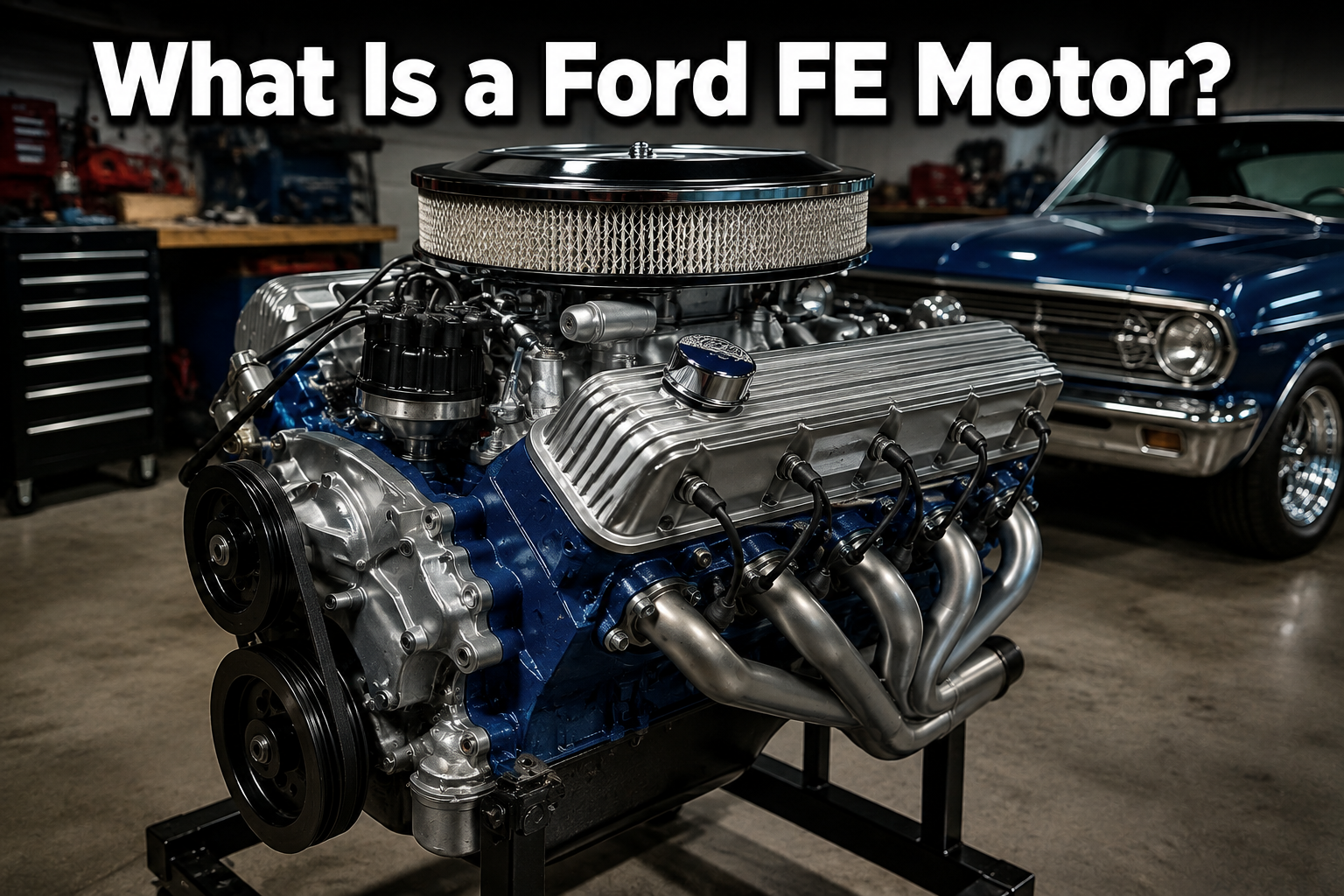
A Ford FE motor is a big-block V8 engine that Ford Motor Company produced from 1958 to 1976, known for its rugged cast iron construction and strong performance reputation. The letters “FE” stand for “Ford-Edsel,” a name tied to the era when Ford and its short-lived Edsel division shared engineering resources.
This engine family powered everything from family sedans to race-winning muscle cars, making it one of the most versatile V8 designs of its time. Displacements ranged from 332 to 428 cubic inches, giving Ford flexibility across different vehicle lineups.
Even decades after production ended, the FE motor remains a favorite among restorers and hot-rodders. Its blend of durability, power, and historical significance is exactly why people still search to understand what is a Ford FE motor today.
What Does “FE” Stand For?
The FE name comes from “Ford-Edsel,” reflecting a specific period in Ford’s corporate history. This naming detail often confuses newcomers who assume it stands for something purely technical.
Origin of the Name
Ford introduced the Edsel brand in the late 1950s as a separate division aimed at competing in the mid-priced car market. During this time, engineering teams worked across both Ford and Edsel lines, and the FE engine was designed to serve both brands simultaneously. This shared development approach is directly reflected in its name.
Common Misconceptions
Many people assume “FE” refers to something like “Ford Engine” or a technical abbreviation related to fuel or efficiency. In reality, the name has nothing to do with engineering terms and is purely a historical reference to the Ford-Edsel partnership that shaped its creation.
History and Background of the Ford FE Motor
Ford launched the FE engine family in 1958 as a replacement for earlier Y-block engines that could no longer meet growing power demands. The engine stayed in production for nearly two decades before being phased out.
When and Why It Was Introduced
By the mid-1950s, Ford needed a more powerful and adaptable engine to compete with rivals offering bigger, stronger V8s.
The FE was designed with room to grow, allowing Ford to increase displacement over the years without redesigning the entire engine block. This adaptability made it a practical long-term investment for the company.
Production Timeline and Discontinuation
The FE engine remained in production from 1958 until 1976, spanning nearly two decades of American automotive history.
As emissions regulations tightened and Ford shifted toward more efficient engine designs, the FE was gradually replaced by the Ford 385 series, also known as the “Lima” big-block family.
Technical Specifications of the Ford FE Motor
The Ford FE motor is classified as a big-block V8 with a thin-wall cast iron block, a design choice that balanced strength with manageable weight for its era. Displacement across the family ranged widely depending on the specific variant.
Block Construction and Displacement
Ford engineered the FE block using thin-wall casting technology, which was relatively advanced for the late 1950s. This allowed the engine to be lighter than typical big-blocks of similar power output while still maintaining structural strength.
Displacement options ranged from 332 cubic inches on the smaller end up to 428 cubic inches on the largest performance variants.
Bore, Stroke, and Compression Details
Bore and stroke measurements varied significantly across FE variants to achieve different performance characteristics, from smooth daily-driver power to aggressive racing output.
Compression ratios also differed widely, with performance-oriented versions like the 427 running much higher compression than standard passenger car variants, reflecting their intended use in racing and high-performance applications.
Popular Ford FE Engine Variants
The FE family included several notable displacement variants, each suited to different vehicles and purposes. The table below summarizes the most recognized versions.
| Variant | Displacement (cu in) | Primary Use |
| 332 | 332 | Early passenger cars |
| 352 | 352 | Standard sedans and trucks |
| 390 | 390 | Most widely used, cars and trucks |
| 406 | 406 | Early performance and racing |
| 427 | 427 | High-performance racing legend |
| 428 | 428 | Muscle cars, Cobra Jet performance |
The 390 and Its Widespread Use
The 390 cubic inch variant became the most common FE engine, appearing in a wide range of Ford vehicles including trucks, sedans, and early Mustangs.
Its balance of reasonable power and everyday reliability made it a practical choice for mainstream buyers rather than just performance enthusiasts.
The 427: A Racing Legend
The 427 cubic inch FE variant earned legendary status through its dominance in NASCAR and drag racing during the 1960s.
Engineered for high RPM performance and reinforced internals, this version proved Ford could compete directly with rival manufacturers on the track, cementing the FE’s reputation in motorsport history.
The 428 and the Cobra Jet
The 428 cubic inch variant, especially the Cobra Jet version, became a favorite in muscle cars like the Mustang and Torino. It delivered strong torque and horsepower suited for street performance, helping define the muscle car era of the late 1960s alongside other iconic American V8s.
Where the Ford FE Engine Was Used
Ford installed FE engines across a broad lineup of vehicles, from everyday family cars to specialized racing machines. This wide application is part of what made the engine family so commercially successful.
Passenger Cars and Trucks
Vehicles like the Ford Galaxie, Fairlane, and Torino relied on FE engines for reliable everyday power. The F-Series trucks also used FE variants, taking advantage of the engine’s durability and torque for hauling and towing tasks.
Muscle Cars and Racing Applications
Performance-focused FE variants powered iconic muscle cars including the Mustang and Shelby models, giving them competitive power for street and track use.
The engine also found its way into racing programs, including a modified version used in the Ford GT40, further boosting its performance credentials.
Performance and Racing Legacy
The FE engine played a significant role in shaping Ford’s motorsport reputation during the 1960s, particularly through NASCAR and drag racing success.
Its adaptability across different displacement and tuning levels made it suitable for multiple racing formats.
NASCAR and Drag Racing Impact
FE-powered vehicles, especially those using the 427 variant, became fixtures in NASCAR competition, helping Ford secure numerous race wins throughout the decade. Drag racers also embraced the engine for its ability to be modified for extreme horsepower output, further building its performance legacy.
Why the 427 Became Iconic
The 427’s combination of high-revving capability and robust internals made it a favorite among racers who needed reliable power under extreme conditions.
This reputation carried into popular culture, making the 427 one of the most recognized engine names among classic car enthusiasts even today.
Ford FE Engine in Modern Restoration Culture
Decades after production ended, the FE motor remains popular among classic car restorers and hot-rodding communities. Its simple mechanical design makes it approachable for enthusiasts working on personal projects.
Why Enthusiasts Still Choose the FE
Restorers value the FE for its historical authenticity and the satisfaction of maintaining a piece of automotive heritage in period-correct vehicles.
Its mechanical simplicity compared to modern engines also makes it easier to work on without specialized diagnostic equipment.
Parts Availability and Aftermarket Support
A strong aftermarket industry continues to support FE engine builds, offering everything from replacement blocks to performance upgrades.
This ongoing support has helped keep the engine viable for both restoration projects and custom performance builds well into the present day.
Pros and Cons of the Ford FE Engine
Like any engine design, the FE comes with distinct advantages and limitations that buyers and restorers should understand before committing to a project.
Advantages:
- Strong durability and long service life
- Wide range of displacement options for different needs
- Iconic sound and performance character
- Extensive aftermarket parts support
Limitations:
- Heavier compared to some modern engine designs
- Lower fuel efficiency by today’s standards
- Some rare parts can be harder to source
- Requires more manual maintenance than modern engines
How to Identify a Ford FE Engine
Identifying an FE engine correctly is important for restoration accuracy and resale value, especially since visual similarities exist across different Ford engine families.
Casting Numbers and Codes
Every FE engine block carries casting numbers stamped into the metal, which can be cross-referenced with Ford parts catalogs to confirm the exact variant and production year.
These numbers are typically the most reliable identification method for serious buyers and restorers.
Visual Identification Tips
Beyond casting numbers, physical characteristics like block dimensions, valve cover shape, and bellhousing bolt patterns can help distinguish FE engines from other Ford V8 families.
Comparing these details against reference photos or enthusiast forums can confirm authenticity when documentation is unavailable.
Buying and Maintaining a Ford FE Engine
Purchasing a used FE engine requires careful inspection, since age and prior use significantly affect long-term reliability and performance.
What to Check Before Buying
Buyers should inspect for cracks in the block, signs of overheating, and unusual wear on internal components before finalizing a purchase.
Requesting compression test results and reviewing maintenance history, when available, can help avoid costly surprises after the sale.
Basic Maintenance Tips
Regular oil changes, cooling system checks, and periodic inspection of belts and hoses go a long way in preserving an FE engine’s lifespan.
Because these engines are decades old, proactive maintenance is especially important compared to newer engine designs.
FAQs About the Ford FE Motor
What does FE stand for in Ford engines?
FE stands for “Ford-Edsel,” referencing the shared engineering period between the two divisions during the engine’s development.
Which Ford FE engine is the most powerful?
The 427 cubic inch variant is widely considered the most performance-focused FE engine, known for its racing success.
Is the Ford FE engine still used today?
While no longer in production, many FE engines remain active in restored classic cars and custom hot-rod builds.
What vehicles came with an FE engine?
Models like the Ford Galaxie, Mustang, Torino, and F-Series trucks commonly featured FE engines.
Conclusion
Understanding what is a Ford FE motor means appreciating a piece of American automotive history that balanced everyday practicality with genuine racing performance.
From its Ford-Edsel origins to its legendary 427 and 428 variants, this engine family left a lasting mark on both passenger vehicles and motorsport. Its continued popularity among restorers proves that solid engineering never truly goes out of style.
Related Articles
How Long Do Ford Fusions Last? Complete Mileage and Longevity Guide