
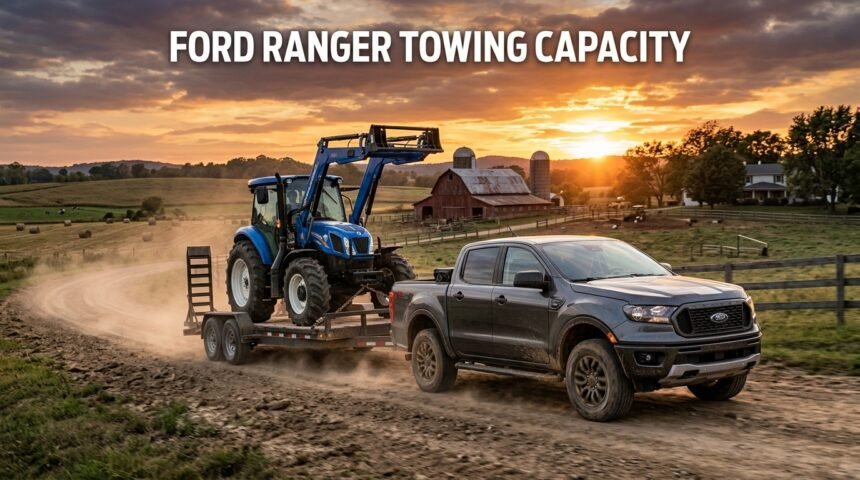
The Ford Ranger towing capacity is one of the biggest reasons buyers choose this midsize truck over an SUV or a full-size pickup. When properly equipped, the Ranger can pull up to 7,500 pounds, a figure that puts it ahead of several rivals in its class.
This capability comes from a mix of strong EcoBoost engines, a purpose-built Trailer Tow Package, and smart towing technology. Whether the truck is used for weekend camping trips, hauling a boat, or moving jobsite equipment, understanding these numbers helps buyers pick the right configuration. The sections below break the Ford Ranger towing capacity down by trim, engine, and real-world use so the decision feels simple rather than confusing.
What Is Towing Capacity?
Towing capacity refers to the maximum weight a vehicle can safely pull behind it, and it is calculated using several connected figures rather than one single number. Two terms often get mixed up with towing capacity, and clearing them up makes the rest of this guide easier to follow.
Towing Capacity vs Payload Capacity
Towing capacity measures what the truck can pull behind it using a hitch, while payload capacity measures what the truck can carry inside the cabin and bed.
These numbers are separate but connected, because extra weight in the bed can reduce how much a truck is allowed to tow safely. Buyers who plan to load gear and tow at the same time need to check both figures together, not just one of them.
Understanding GCWR
GCWR stands for Gross Combined Weight Rating, and it represents the total allowable weight of the truck, passengers, cargo, and trailer combined.
The Ford Ranger carries a maximum GCWR of 12,745 pounds, which sets the outer limit for how much weight the entire setup can reach. Staying within this rating protects the engine, transmission, brakes, and suspension from unnecessary strain during long trips.
2026 Ford Ranger Towing Capacity by Trim & Engine
The Ford Ranger towing capacity stays fairly consistent across most trims, with one clear exception in the lineup. The table below makes the differences easy to scan at a glance.
| Trim / Engine | Drivetrain | Max Towing Capacity |
|---|---|---|
| XL – 2.3L EcoBoost I-4 | 4×2 / 4×4 | 7,500 lbs |
| XLT – 2.3L EcoBoost I-4 | 4×2 / 4×4 | 7,500 lbs |
| Lariat – 2.7L EcoBoost V6 | 4×2 / 4×4 | 7,500 lbs |
| Ranger Raptor – 3.0L EcoBoost V6 | 4×4 | 5,510 lbs |
XL, XLT and Lariat Towing Capacity
These three trims all reach the same maximum towing capacity of 7,500 pounds once fitted with the Trailer Tow Package. This consistency means buyers do not have to choose a higher trim purely for towing muscle, since even the base XL matches the Lariat’s rating. Standard features and interior comfort become the real deciding factors between these three trims.
Ranger Raptor Towing Capacity
The Ranger Raptor is rated to tow up to 5,510 pounds, noticeably lower than the rest of the lineup. This trade-off happens because the Raptor’s suspension geometry, wider tires, and increased curb weight are tuned for off-road performance rather than maximum pulling power. Buyers who need the highest towing numbers should look toward the XL, XLT, or Lariat instead of the Raptor.
Engine Options and Their Towing Performance
Three engine choices are available across the Ranger lineup, and each one plays a role in shaping the truck’s towing behavior. Horsepower and torque numbers differ, but two of the three engines still land on the same top towing figure.
2.3L EcoBoost I-4
The base engine produces 270 horsepower and 310 lb-ft of torque, paired with a 10-speed automatic transmission in every trim.
Despite being the entry-level option, it still delivers the full 7,500-pound towing capacity when the Trailer Tow Package is added. This makes it an efficient and budget-friendly choice for owners who tow occasionally rather than daily.
2.7L EcoBoost V6
Stepping up to the V6 brings 315 horsepower and 400 lb-ft of torque, giving drivers noticeably stronger pulling power at lower speeds. While the maximum towing number stays the same at 7,500 pounds, the extra torque provides more comfortable acceleration and highway merging with a loaded trailer. This engine suits owners who tow heavier loads on a more regular basis.
3.0L EcoBoost V6 Raptor Engine
Exclusive to the Raptor trim, this twin-turbo V6 generates 405 horsepower and 430 lb-ft of torque, the strongest output in the lineup. However, because the Raptor is built for off-road capability rather than hauling, its towing rating drops to 5,510 pounds. This shows that raw power alone does not determine towing capacity, since suspension tuning and vehicle weight matter just as much.
What You Need To Reach Maximum Towing Capacity
Reaching the full Ford Ranger towing capacity requires more than just picking the right engine, since specific hardware has to be added to the truck. The Trailer Tow Package sits at the center of this setup and unlocks the truck’s full pulling potential.
Trailer Tow Package Features
This package includes a Class IV trailer hitch receiver, a 4/7-pin wiring harness, Tow/Haul Mode, and Trailer Sway Control as standard inclusions. Without this package, the Ranger’s towing capacity drops sharply to just 3,500 pounds. Adding this equipment is essential for anyone planning to tow near the truck’s maximum rated weight.
Additional Towing Technology
Higher trims also offer Pro Trailer Backup Assist, which simplifies reversing a trailer into tight spaces using a rotary dial control. Trail Control acts as a low-speed cruise control for uneven terrain, which helps when approaching a boat ramp or unpaved campsite. These technologies do not raise the towing number itself, but they make towing at high weights noticeably safer and easier to manage.
Payload Capacity and GCWR Explained
Payload capacity works alongside towing capacity to determine how a Ranger can be loaded for a trip. Both figures shift slightly depending on trim, engine, and drivetrain choice.
Payload Capacity by Trim
The 2.3L EcoBoost with 4×2 offers the highest payload in the lineup at up to 1,805 pounds, while 4×4 versions typically carry slightly less.
The 2.7L EcoBoost V6 trades some payload capacity for added towing torque, landing closer to 1,513 pounds depending on configuration. Buyers hauling heavy bed cargo alongside a trailer should always check the current payload sticker on the specific truck they are buying.
How GCWR Affects Towing
Since GCWR covers the truck, occupants, cargo, and trailer as one combined figure, a fully loaded bed can reduce the safe towing weight even if the trailer itself falls under 7,500 pounds.
This is why Ford publishes GCWR separately rather than relying on towing capacity alone. Checking both numbers together prevents owners from unintentionally exceeding safe limits during a fully loaded trip.
Ford Ranger Towing Capacity vs Competitors
Within the midsize truck segment, the Ford Ranger towing capacity holds a competitive position against its closest rivals. Reviewing how it stacks up helps put the 7,500-pound rating into proper context.
Ranger vs Toyota Tacoma
The Ranger’s 7,500-pound towing capacity surpasses the Tacoma in most comparable trims, giving Ford an edge for buyers focused purely on pulling power. Both trucks offer similar midsize practicality, but the Ranger’s EcoBoost engines provide more torque at lower engine speeds. This torque advantage becomes noticeable when towing uphill or merging onto highways with a loaded trailer.
Ranger vs Chevrolet Colorado
The Chevrolet Colorado offers strong towing numbers as well, but the Ranger generally matches or slightly exceeds it depending on the specific engine and trim compared.
Interior technology and available towing aids are fairly close between the two trucks, making engine torque and payload the more meaningful differences. Buyers cross-shopping these two should compare exact trim-to-trim towing figures rather than relying on general class reputation.
Safe Towing Tips for Ford Ranger Owners
Reaching the Ford Ranger towing capacity safely depends on preparation just as much as the truck’s mechanical rating. A few habits make a noticeable difference in stability and control.
Preparing Your Trailer and Load
Distributing weight evenly across the trailer, with slightly more weight toward the front, helps prevent swaying at highway speeds. Checking tire pressure on both the truck and trailer before every trip reduces the risk of blowouts under heavy load. Confirming that trailer brakes and lights are functioning correctly is a simple step that protects against costly accidents.
Using Tow/Haul Mode and Trailer Sway Control
Switching on Tow/Haul Mode adjusts the transmission’s shift points, which reduces gear hunting and improves engine braking on descents.
Trailer Sway Control automatically applies braking to individual wheels if the trailer begins to fishtail, helping the driver regain control quickly. Using these two systems together keeps towing smoother and safer, especially during long highway drives or sudden weather changes.
Frequently Asked Questions
What is the maximum Ford Ranger towing capacity?
The Ranger can tow up to 7,500 pounds when equipped with the Trailer Tow Package, except for the Raptor trim.
Does the Ranger Raptor tow less than other trims?
Yes, the Raptor is rated at 5,510 pounds due to its off-road-focused suspension and added weight.
Can the Ranger tow a fifth-wheel or gooseneck trailer?
No, the Ranger is rated for conventional hitch towing only and is not certified for fifth-wheel or gooseneck setups.
Is the Trailer Tow Package required to tow at all?
Towing is still possible without it, but capacity drops to 3,500 pounds, far below the truck’s full potential.
Conclusion
The Ford Ranger towing capacity of 7,500 pounds makes it a strong choice among midsize trucks, especially when paired with the Trailer Tow Package and the right engine.
Compared to rivals like the Tacoma and Colorado, the Ranger holds a competitive or slightly better position in most towing comparisons. Buyers who match their trim, engine, and towing equipment to their actual hauling needs will get the most reliable performance from this truck.