
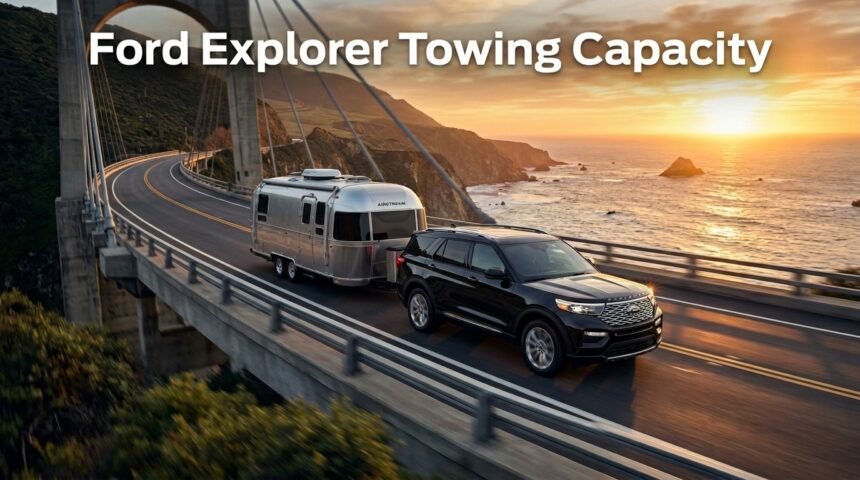
The Ford Explorer towing capacity is one of the biggest reasons families and outdoor enthusiasts choose this SUV over other three-row crossovers. Whether you are hauling a small camper, a fishing boat, a pair of jet skis, or a simple utility trailer, knowing the exact towing numbers helps you plan every trip with confidence.
This guide breaks the topic down trim by trim, engine by engine, and explains the equipment and weight factors that actually decide how much your Explorer can safely pull. By the end, you will understand not just the advertised maximum figure but also what changes that number in daily driving conditions.
Ford Explorer Towing Capacity by Generation
The Ford Explorer towing capacity has shifted slightly between generations as Ford revised engines and tow packages. The current sixth-generation model, built on a rear-wheel-drive-based platform since 2020, generally offers stronger and more consistent numbers than earlier front-wheel-drive-based Explorers.
Current Generation (Sixth Gen)
The present Explorer, offered from 2020 onward, standardized a Class III Trailer Tow Package on every trim. Earlier sixth-generation model years reached up to 5,600 pounds with the 3.0L EcoBoost V6, while the most recent model year settled at a flat 5,000-pound rating across the lineup for simplicity.
Previous Generation (Fifth Gen)
The fifth-generation Explorer used a front-wheel-drive-based platform, which limited towing to roughly 5,000 pounds on its strongest V6 configuration. It lacked the rear-wheel-drive foundation that gives the current model better weight distribution when a trailer is attached.
How Towing Capacity Has Changed Over the Years
Ford has adjusted the Ford Explorer towing capacity almost every redesign cycle based on engine output, chassis stiffness, and cooling upgrades. Buyers comparing model years should always check the specific year and trim rather than assuming older or newer automatically means stronger, since ratings have moved both up and down over time.
Towing Capacity by Trim Level
Every current Explorer trim ships with the Class III Trailer Tow Package as standard equipment, which keeps the Ford Explorer towing capacity consistent across most of the lineup rather than reserving it for higher trims only.
Base, XLT, and Active Trims
These entry-level trims use the standard 2.3L EcoBoost engine and still carry a strong towing rating suitable for most family needs. They comfortably handle small to medium campers, aluminum boats, and loaded utility trailers without needing an upgrade.
Limited and Platinum Trims
The Limited and Platinum trims add comfort and technology features while keeping towing performance in line with the rest of the range. Buyers get the same Class III hardware, so the towing number does not drop simply because you choose a more luxurious interior.
ST Performance Trim
The ST trim uses the most powerful available engine and historically posted the highest Ford Explorer towing capacity in the lineup. Its stiffer suspension tuning and larger brakes also make it feel more planted when a loaded trailer is attached during highway driving.
Timberline and Off-Road Trims
The Timberline-style trim focuses on ground clearance and all-terrain tires rather than raw towing numbers, though it still carries the standard Class III package. It suits owners who need to reach a rougher campsite or boat ramp before hitching up.
Hybrid Model
The Explorer Hybrid, offered in earlier model years before being discontinued from the lineup, carried a noticeably lower towing figure than the gas-only trims. Its lower rating reflected the added weight of the battery pack and the different cooling demands of a hybrid powertrain.
Engine Options and Their Impact on Towing
The engine under the hood plays the single biggest role in determining Ford Explorer towing capacity, since torque delivery is what actually moves a loaded trailer up a grade or through a highway merge.
2.3L EcoBoost Turbo Engine
This four-cylinder turbo engine is the standard powerplant across most trims and produces around 300 horsepower with roughly 310 pound-feet of torque. It provides more than enough pulling power for typical weekend towing, including mid-size travel trailers and boats.
3.0L EcoBoost V6 (ST Engine)
The optional twin-turbo V6 delivers substantially more horsepower and torque than the four-cylinder, which historically pushed the Ford Explorer towing capacity toward the top of its range. This engine feels noticeably stronger when towing heavier loads at highway speed or on hilly terrain.
How Horsepower and Torque Affect Towing
Torque matters more than horsepower for towing because it determines how easily the SUV can get a heavy trailer moving from a stop. A higher-torque engine also reduces strain on the transmission and cooling system during long uphill pulls.
Understanding “Properly Equipped” Towing Numbers
Every advertised Ford Explorer towing capacity figure comes with the phrase “properly equipped,” which is a detail many buyers overlook until they are already shopping for a trailer.
What the Class II Tow Package Includes
A lighter-duty tow package typically includes a basic wiring harness and smaller hitch receiver, intended for light trailers rather than maximum-rated loads. It is less common on the current Explorer since Class III is now standard across trims.
What the Class III Tow Package Includes
The Class III package includes a heavy-duty hitch receiver, upgraded wiring for trailer lights and brakes, and often an auxiliary transmission cooler. This is the hardware combination Ford uses to certify the maximum advertised towing figure.
Difference Between Advertised Max and Real-World Capacity
The advertised maximum number assumes a single 150-pound driver, minimal cargo, and no additional passengers. Real-world capacity is almost always lower once you add family members, luggage, and camping gear into the equation.
Factors That Affect Actual Towing Capacity
Several everyday variables reduce the usable Ford Explorer towing capacity below the number printed in the brochure, and understanding them prevents overloading the vehicle.
Passenger and Cargo Weight
Every passenger, cooler, and piece of luggage inside the Explorer eats directly into the available payload, which in turn limits how much tongue weight the trailer can safely add. A full seven-passenger load can noticeably shrink your safe towing margin.
Trailer Type and Terrain
Enclosed trailers create more wind resistance than open utility trailers, which increases strain on the engine and fuel economy at highway speed. Mountainous terrain and high elevation also reduce effective towing power because engines lose some output in thinner air.
Weather and Aftermarket Modifications
Hot weather increases the risk of engine and transmission overheating during sustained towing, so many owners tow more conservatively in summer. Aftermarket wheels, lift kits, or non-Ford hitches can also affect the vehicle’s certified rating and should be checked against Ford’s official guidance.
How to Calculate Your Explorer’s Real Towing Limit
Knowing the theoretical Ford Explorer towing capacity is only useful if you can translate it into a safe number for your specific loaded vehicle.
Understanding GVWR and GCWR
Gross Vehicle Weight Rating (GVWR) is the maximum weight of the Explorer itself, including passengers and cargo, while Gross Combined Weight Rating (GCWR) covers the SUV and trailer together. Staying under GCWR is the single most important safety check before any tow.
Payload vs Towing Capacity
Payload capacity refers to weight carried inside or on top of the Explorer, while towing capacity refers to weight pulled behind it through the trailer hitch. Tongue weight, which is part of the payload equation, typically runs about ten to fifteen percent of the total trailer weight.
A Simple Formula for Your Safe Number
Subtract the combined weight of passengers, cargo, and tongue weight from your GVWR to see how much payload headroom remains. If that number is tight, you may need to lighten the interior load even if the trailer itself is within the maximum towing rating.
What Can You Tow With a Ford Explorer?
The table below gives a general idea of common loads that fall within a typical Ford Explorer towing capacity range, though actual weights vary by manufacturer and options.
| Item | Typical Loaded Weight | Fits Within Explorer Towing Capacity |
|---|---|---|
| Pop-up or small travel trailer | 2,000–3,500 lbs | Yes, on most trims |
| Mid-size fishing or pontoon boat | 3,000–4,500 lbs | Yes, with Class III package |
| Enclosed utility trailer | 1,500–3,000 lbs | Yes, on all trims |
| Pair of jet skis on a trailer | 1,200–1,800 lbs | Yes, on all trims |
| Light-duty horse trailer (one horse) | 4,000–5,000 lbs | Yes, only on higher-torque engine trims |
Small campers, pontoon boats, and utility trailers make up the bulk of what everyday Explorer owners tow, and each of these categories fits comfortably within the SUV’s rated limits when loaded sensibly.
Required Towing Equipment
Beyond the factory tow package, a few additional accessories make towing with an Explorer noticeably safer and easier to manage.
Hitch, Wiring, and Brake Controller
A properly rated hitch receiver and matching ball mount are essential, along with a seven-pin wiring harness for trailer lights and, for larger trailers, an integrated brake controller. Skipping the brake controller on heavier trailers significantly increases stopping distance.
Weight-Distribution Hitch and Towing Mirrors
A weight-distribution hitch helps level the SUV and trailer when pulling loads near the upper end of the Ford Explorer towing capacity, improving steering feel and reducing sway. Extended towing mirrors are also worth adding for enclosed trailers that block the standard side mirror view.
Tips for Safe Towing
Good habits behind the wheel matter just as much as the numbers on the spec sheet when it comes to towing an SUV safely.
Pre-Trip and On-Road Habits
Always check tire pressure, trailer lights, and hitch security before leaving, and plan for longer braking distances the entire trip. Reducing speed on grades and in windy conditions keeps the loaded Explorer stable and predictable.
Ford Explorer vs Competitors (Towing Comparison)
Compared with rivals in the midsize three-row segment, the Ford Explorer towing capacity generally sits at or above the class average, though a few competitors edge ahead with larger engines. The Toyota Grand Highlander and Chevrolet Traverse both max out around 5,000 pounds on their strongest non-hybrid setups, matching the Explorer’s current standard rating.
The Honda Pilot trails slightly on base front-wheel-drive models before reaching a similar 5,000-pound ceiling on properly equipped trims. The Jeep Grand Cherokee L stands apart with a notably higher maximum rating thanks to its available six-cylinder and turbocharged engine options, making it the strongest overall puller in this comparison set, though it does not match the Explorer’s blend of cargo room and everyday efficiency.
Frequently Asked Questions
Can a base Explorer tow a camper?
Yes, the base engine with the standard Class III package comfortably tows small to mid-size campers under its rated limit.
Does the Hybrid Explorer tow well?
The Hybrid trim’s towing figure was noticeably lower than gas-only trims, so it suits light-duty trailers rather than heavy loads.
What is the difference between max and safe towing?
Max towing is the certified brochure number, while safe towing accounts for your actual passengers, cargo, and tongue weight on that trip.
Do I need a special license to tow with an Explorer?
In most regions a standard driver’s license is sufficient for Explorer-sized trailers, but always confirm local weight-based licensing rules.
Conclusion
The Ford Explorer towing capacity remains one of the more dependable figures in the midsize SUV class, especially with the Class III package standard across the lineup.
Choosing the right engine, respecting payload limits, and adding the correct hitch equipment are what turn a brochure number into a safe, comfortable towing experience. For the exact rating on your specific model year and trim, always confirm the figure with your owner’s manual or a Ford dealer before hitching up.
Related Articles
What Is the Ford FX4 Package? Complete Guide to Features, Benefits & Cost
Does Ford Use Standard or Metric? A Complete Guide
How Long Do Ford Fusions Last? Complete Mileage and Longevity Guide
Does the Ford Edge Have a 3rd Row? Full Seating Guide (2026)
How Tall Is a Ford F-150? A Complete Height Guide by Trim, Cab, and Year