
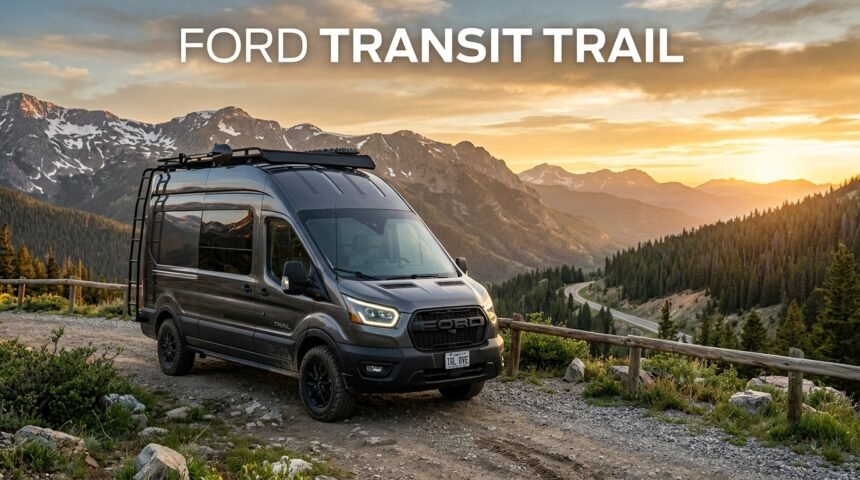
The Ford Transit Trail is a factory-built, off-road-ready version of the standard Ford Transit van, designed for buyers who want extra ground clearance, better traction, and rugged styling without adding aftermarket parts. It combines a raised suspension, all-wheel-drive hardware, and tougher exterior trim into one ready-to-use package.
This model has become especially popular among van-life travelers and camper van builders because it reduces the amount of custom work needed before a conversion. Whether someone wants a weekend adventure vehicle or a base platform for a full camper build, the Ford Transit Trail offers a strong starting point. The sections below explain its background, features, performance, pricing, and how it compares with other vans in the same category.
History and Background
The Ford Transit Trail was not built overnight; it grew out of Ford’s effort to give commercial van buyers more capability for rough terrain. The idea first appeared in Europe before eventually reaching the North American market a few years later.
European Launch
Ford first introduced the Trail concept in the UK and other European markets in 2020, alongside a related trim called Active. This version paired a mechanical limited-slip differential with reinforced styling to help vans handle loose or slippery job sites. It targeted tradespeople who regularly worked in difficult outdoor conditions rather than recreational travelers.
US Introduction
The American version of the Ford Transit Trail arrived for the 2023 model year with a different focus: outdoor recreation and van conversions. Ford marketed it directly toward the growing van-life community, adding a suspension lift, all-terrain tires, and swivel seats that made it far more suitable for camping trips than the earlier European work-focused trims.
Design and Exterior Features
The exterior of the Ford Transit Trail is built to look and function differently from a standard cargo van. A noticeable body lift raises the entire vehicle, while wider tires and reinforced wheel arches give it a sturdier stance on gravel or dirt roads. Ford also added visual details such as unique badges, black trim, and a more protective front bumper design so the van stands out from regular commercial models.
Several exterior upgrades are included as standard equipment rather than optional extras, which is one reason builders prefer this trim over a base Transit. The main highlights include the following:
- A raised ride height created through a factory suspension lift
- Wider track width for improved stability on uneven surfaces
- All-terrain tires mounted on matte black alloy wheels
- A skid-plate style front bumper for added front-end protection
- Side steps that make entry easier at the increased ride height
These changes are functional rather than purely cosmetic, since they directly affect how the van performs once it leaves paved roads.
Interior Features and Technology
Inside the cabin, the Ford Transit Trail keeps a mostly work-van layout but adds comfort details suited to long trips. The two front seats are typically swivel-capable, allowing them to rotate toward the cargo area once parked, which is especially useful for camper conversions where the front seats double as living space seating. Durable materials cover most surfaces since the van is expected to handle dirt, gear, and frequent loading.
On the technology side, the cabin includes a touchscreen infotainment system with smartphone connectivity, a digital instrument cluster, and available driver-assist features such as adaptive cruise control and a surround-view camera. Charging ports and practical storage areas, including a dash-top shelf and door pockets, round out the interior. None of these features are unusual for a modern van, but having them bundled together in one trim saves buyers from selecting each option separately.
Engine, Transmission and AWD System
Under the hood, the Ford Transit Trail relies on Ford’s turbocharged V6 engine, which is shared with other high-output Transit variants. This engine is paired with a ten-speed automatic transmission that manages power delivery smoothly across a wide range of driving conditions, from city streets to unpaved trails.
| Specification | Detail |
|---|---|
| Engine | 3.5L twin-turbocharged EcoBoost V6 |
| Horsepower | Around 310 hp |
| Torque | Approximately 400 lb-ft |
| Transmission | 10-speed automatic |
| Drivetrain | Intelligent all-wheel drive |
The all-wheel-drive system used in the Trail is an on-demand setup rather than a permanently locked four-wheel system. It automatically shifts power between the front and rear axles depending on traction needs, which works well on snow, mud, and loose dirt, though it is not designed for extreme rock-crawling situations.
Off-Road Capability and Drive Modes
Off-road capability is one of the biggest selling points of the Ford Transit Trail, but it is important to understand its actual limits before assuming it can handle any terrain. The added ride height and reinforced underbody give it a real advantage over a standard Transit when tackling gravel roads, muddy campsites, or snow-covered routes.
The van includes selectable drive modes such as Slippery and Mud/Rut settings, which adjust throttle response and traction control to suit the surface. An AWD Lock mode is also available, splitting power evenly between the front and rear axles when extra grip is needed. However, since the system is electronically controlled rather than mechanically locked like a traditional 4×4 transfer case, it is better suited to moderate off-road conditions than to serious rock-crawling trails.
Configurations, Trims and Body Styles
Buyers can choose the Ford Transit Trail in a few different body configurations depending on how much interior space they need. The table below summarizes the main options typically offered.
| Configuration | Roof Height | Best Suited For |
|---|---|---|
| Long wheelbase, medium roof | Medium | Balanced cargo space and lower overall height |
| Long wheelbase, high roof | High | Standing room for camper conversions |
| Extended length, high roof | High | Maximum interior space for larger builds |
All versions share the same drivetrain and suspension upgrades, so the choice mostly comes down to how much room a buyer needs for seating, storage, or a camper interior.
Ford Transit Trail Pricing
Pricing for the Ford Transit Trail sits noticeably higher than a standard Transit cargo van because of the added hardware and equipment bundled into the package. The exact figure depends on body length, roof height, and any additional factory options selected at the time of order.
| Item | Approximate Cost |
|---|---|
| Base Transit Trail price | Around $65,000–$67,000 |
| Premium package add-on | Roughly $11,000–$12,000 above standard Transit |
| Destination fee | Around $1,800 |
Because it comes from the factory with a full warranty, many buyers find the higher price acceptable compared to paying for aftermarket lift kits and off-road accessories separately, which could void portions of a standard warranty if installed incorrectly.
Van Life and Camper Conversion Potential
The Ford Transit Trail has become a favorite among camper van builders largely because it removes several early conversion steps. Since the suspension lift, all-terrain tires, and AWD system already come installed, builders can focus their time and budget on the interior living space instead of mechanical upgrades.
Payload capacity remains strong despite the added off-road hardware, which matters for anyone planning to install cabinetry, water tanks, or solar equipment. Many owners add extras such as roof-mounted ventilation fans, awnings, and heavy-duty tow packages to round out their build. Because the Trail keeps the same wheelbase and roof options as other Transit vans, interior layout choices are not limited by the off-road equipment underneath.
Pros and Cons
Every vehicle involves trade-offs, and the Ford Transit Trail is no exception. The table below outlines the main strengths and weaknesses reported by owners and reviewers.
| Pros | Cons |
|---|---|
| Factory warranty covers off-road hardware | Not designed for extreme rock-crawling |
| Reduces need for aftermarket lift kits | Noticeably higher price than base Transit |
| Strong payload for camper conversions | Fuel economy drops slightly due to lift and tires |
| AWD improves traction in snow and mud | Limited to two-seat cargo configurations in some trims |
Ford Transit Trail vs Competitors
When compared with rival adventure-ready vans, the Ford Transit Trail holds a distinct position because it is available directly from the factory rather than requiring a third-party upfit.
The Mercedes-Benz Sprinter offers a 4×4 option with similar off-road intent, but it typically costs more once comparable features are added. The Ram ProMaster, on the other hand, does not offer a factory all-wheel-drive or lifted trim at all, making it a weaker choice for buyers specifically seeking off-road readiness.
| Van | Factory Off-Road Trim | AWD/4×4 Availability |
|---|---|---|
| Ford Transit Trail | Yes | Yes, on-demand AWD |
| Mercedes-Benz Sprinter 4×4 | Yes | Yes, part-time 4×4 |
| Ram ProMaster | No | Not available |
This comparison shows that the Ford Transit Trail competes closely with the Sprinter 4×4 in capability, while offering an edge in factory-backed affordability for buyers who want off-road readiness without heavy customization.
Buying Guide for New and Used Models
Buyers considering a Ford Transit Trail should first decide between a new factory order or a used unit, since new orders allow full customization of roof height, length, and optional packages. Used models may offer savings but require careful inspection of tires, suspension components, and any recall history tied to specific model years.
It is also worth confirming whether the van has already been upfitted for camper use, since a professionally converted Trail may carry a higher price but save significant build time. Checking warranty status is important too, as the extended powertrain coverage typically remains active for several years from the original in-service date regardless of ownership changes.
Frequently Asked Questions
Is the Ford Transit Trail good for off-roading?
It performs well on gravel, mud, and snow but is not built for extreme rock-crawling like a dedicated off-road truck.
How much more does the Trail package cost compared to a standard Transit?
The Trail package typically adds around eleven to twelve thousand dollars over a comparable standard Transit configuration.
Can the Ford Transit Trail be converted into a camper van?
Yes, it is one of the most popular factory platforms for camper conversions due to its built-in AWD and ground clearance.
Does the Transit Trail come in passenger versions?
Most Trail models are sold as two-seat cargo vans, though upfitters can add passenger seating during conversion.
Conclusion
The Ford Transit Trail offers a practical middle ground between a standard commercial van and a fully custom off-road build. Its factory-installed lift, AWD system, and rugged styling make it especially appealing to camper van builders and outdoor travelers who want capability without extensive modification.
While it is not meant for extreme off-roading, it comfortably handles the rough roads and unpredictable weather most adventure travelers actually encounter, making it a strong choice within its category.
Related Articles
Does Ford Use Standard or Metric? A Complete Guide
What Is the Ford FX4 Package? Complete Guide to Features, Benefits & Cost
How Long Do Ford Fusions Last? Complete Mileage and Longevity Guide