
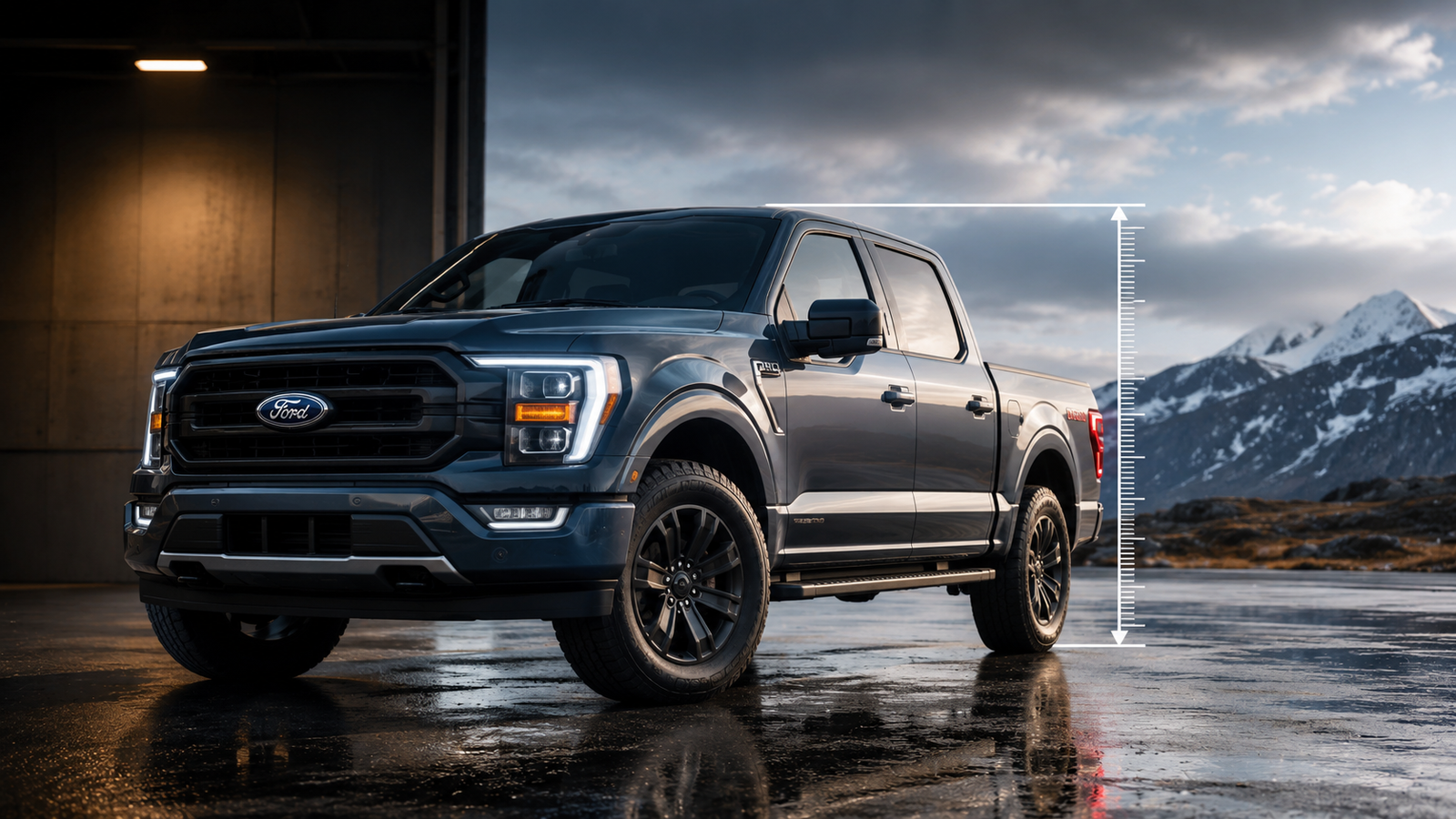
If you’ve ever pulled up to a parking garage with a low clearance sign, backed into your garage a little too fast, or just wondered whether your new truck will fit under that carport, you’ve probably asked yourself: How Tall Is a Ford F-150 It’s one of those questions that sounds simple but actually has a handful of different answers, because Ford’s best-selling pickup comes in so many shapes and setups.
The short answer is that most Ford F-150 models stand somewhere between 75 and 78 inches tall, or roughly 6.3 to 6.5 feet. But that number shifts depending on the cab style you choose, whether you’re driving a two-wheel-drive or four-wheel-drive version, the size of your tires, and even which model year you’re looking at. Off-road trims like the Raptor push closer to 80 inches, while the all-electric F-150 Lightning sits taller still.
This guide breaks all of that down in plain language, with tables you can scan quickly and explanations that go a little deeper for anyone who wants the full picture. Whether you’re shopping for a new truck, checking whether it’ll clear your garage door, or just satisfying your curiosity, you’ll find the answer to how tall is an F150 for pretty much every configuration Ford sells.
1. Ford F-150 Height at a Glance
Before diving into every trim and cab combination, here’s a quick snapshot so you can get your answer and move on if you’re in a hurry.
| Category | Approximate Height |
|---|---|
| Standard F-150 (2WD) | 75 – 76 inches |
| Standard F-150 (4WD) | 77 – 78.5 inches |
| F-150 Tremor (off-road package) | 77 – 78 inches |
| F-150 Raptor | 79 – 80 inches |
| F-150 Lightning (electric) | 79.3 – 79.8 inches |
| With a 4-6 inch lift kit | 81 – 84+ inches |
As you can see, the gap between the shortest and tallest F-150 on the road can be nearly half a foot, which is a bigger difference than most people expect from what looks, at first glance, like “just a pickup truck.”
2. Height by Cab Style
Ford builds the F-150 in three distinct cab styles, and cab style alone can shift the total height by an inch or two because of how the roofline and suspension setup are engineered for each configuration.
Regular Cab is the simplest, two-door version of the F-150, generally sitting in the 75.2 to 75.6 inch range. It’s the least common configuration on dealer lots today, since most buyers prefer more passenger space, but it remains the base option and tends to be the shortest overall.
SuperCab adds a second row of smaller, rear-hinged doors and extra cabin space. Heights typically run from 75.4 to about 77.1 inches, with four-wheel-drive and off-road-oriented trims landing near the top of that range.
SuperCrew is the four-full-door, most spacious cab and the one most F-150 buyers choose. It typically measures 75.6 to 77.6 inches, though this can climb higher on 4WD and off-road trims.
| Cab Style | Typical Height Range |
|---|---|
| Regular Cab | 75.2 – 75.6 in |
| SuperCab | 75.4 – 77.1 in |
| SuperCrew | 75.6 – 77.6 in |
3. Height by Trim Level
Trim level itself doesn’t usually change height as dramatically as cab style or drivetrain does, since most trims (XL, XLT, Lariat, King Ranch, Platinum, Limited) share the same basic body and suspension when configured with the same cab and drivetrain. The real height differences show up with the specialty and performance trims.
- XL, XLT, Lariat, King Ranch, Platinum, Limited: These trims generally follow the standard cab-style height ranges shown above. The main driver of height differences among them is whether the truck is 2WD or 4WD, not the trim badge itself.
- Tremor: Built for moderate off-roading, the Tremor package adds larger all-terrain tires and a mild suspension lift, nudging height up a bit compared to a standard 4×4.
- Raptor: Ford’s desert-racing-inspired performance trim rides noticeably taller, generally in the 79 to 80 inch range, thanks to long-travel suspension, 35-to-37-inch tires, and increased ground clearance built for high-speed off-road driving.
- F-150 Lightning: The electric F-150 carries its battery pack low in the frame but still ends up one of the tallest F-150 variants overall, typically 79.3 to 79.8 inches, depending on trim.
So if you’re asking how tall is an F150 Raptor specifically, expect an answer closer to 80 inches rather than the 75-to-76-inch figure that applies to a base XL model.
4. Factors That Affect Height
A handful of variables can push any individual F-150’s height up or down from the “typical” figures listed above, and it’s worth understanding each one if you need a precise number for your specific truck.
Two-wheel drive versus four-wheel drive makes one of the biggest differences. A 4×2 F-150 usually sits around 75 to 76 inches tall, while an otherwise identical 4×4 model rides about 1.5 to 1.7 inches higher, landing closer to 77 to 78.5 inches, simply because of the raised suspension and larger tire and wheel package that four-wheel-drive systems require.
Wheel and tire size plays a role too. A truck riding on smaller 17-inch wheels with taller sidewall tires can measure differently than the same truck on 20-inch or larger wheels with a lower-profile tire, even though the overall rolling diameter is often engineered to stay similar.
Suspension lift kits are the biggest wildcard of all, since these are aftermarket additions rather than factory specs. A modest 2-to-3-inch leveling kit will add roughly that much to the total height, while dedicated 4-to-6-inch lift kits (popular among off-road enthusiasts) can push some F-150s well past 80 or even 84 inches tall.
Roof racks, light bars, and antennas are minor by comparison but can still add a few inches, which matters if you’re squeezing into a garage or parking structure with a tight clearance limit.
Bed length doesn’t affect height directly, but it’s often specified alongside height on window stickers and spec sheets, so it’s worth noting the two are separate measurements entirely.
5. Height Across F-150 Model Years
The F-150 has gone through multiple generations, and while the general height range has stayed fairly consistent over the past two decades, there have been some shifts worth knowing about if you’re comparing an older model to a newer one.
| Model Years | Generation | Typical Height Range |
|---|---|---|
| 2004 – 2008 | Eleventh generation | 73.5 – 76.1 inches |
| 2009 – 2014 | Twelfth generation | Low-to-mid 70s, up to 76–77 in for off-road/heavy-duty setups |
| 2015 – 2020 | Thirteenth generation | Similar range to prior generation, roughly 71.5–75 in for base configs |
| 2021 – 2026 | Fourteenth generation (current) | 75.2 – 77.6 in standard, up to ~80 in for Raptor/Lightning |
The current fourteenth-generation F-150, which has been in production since 2021 and continues through at least the 2026 model year, keeps essentially the same body footprint and roofline throughout, so height figures for a 2021 model and a 2026 model in the same configuration should be nearly identical.
Older trucks from the 2004-2014 era tended to sit a bit lower on average, particularly in base regular-cab, two-wheel-drive form.
6. F-150 Height vs. Other Trucks
If you’re cross-shopping, it helps to see how the F-150 stacks up against its closest full-size rivals in similar crew-cab, short-bed configurations.
| Truck (Crew/SuperCrew, short bed) | Approximate Height |
|---|---|
| Ford F-150 SuperCrew | 75 – 78 inches |
| Chevrolet Silverado 1500 Crew Cab | ~75.5 inches |
| Ram 1500 Crew Cab | ~77.5 inches |
| Toyota Tundra CrewMax | ~78.0 inches |
In practical terms, these trucks are all within a couple of inches of one another, so height alone rarely decides which one is “right” for a buyer. The bigger differentiators tend to be ground clearance, towing capacity, and interior packaging rather than the outer height figure.
Among off-road performance trims specifically, the F-150 Raptor and its rivals (like the Ram 1500 RHO or the outgoing Ram 1500 TRX) are also closely matched, generally landing in the high-70s to low-80s range once you account for their taller suspension and larger off-road tires.
7. Why F-150 Height Matters (Practical Uses)
Knowing exactly how tall your F-150 is isn’t just trivia. It has real, everyday consequences.
Garage clearance is probably the number one reason people search for this information. A standard residential garage door opening is about 7 feet (84 inches), so most F-150 configurations will clear a standard garage with a few inches to spare. However, a Raptor, a Lightning, or any F-150 with a lift kit can get uncomfortably close to that ceiling, especially once you add a roof rack or antenna.
Parking garages and drive-thrus often post clearance limits between 6.5 and 7 feet, and a taller 4×4 or lifted F-150 can bump right up against those limits. It’s worth checking your exact height (see the next section) before assuming you’ll fit.
Car washes, particularly older automatic tunnel washes, frequently have clearance restrictions in a similar range, and this is a common spot where taller trucks get turned away or, worse, damaged.
Towing and hauling stability is also connected to height, since a taller center of gravity can affect how a loaded truck handles, particularly in crosswinds or during sharp maneuvers.
Off-road ground clearance is the flip side of the coin. For Raptor owners and other off-road enthusiasts, that extra height isn’t a nuisance, it’s the whole point, since it directly translates into the ground clearance needed to clear rocks, ruts, and uneven terrain.
8. How to Measure Your F-150’s Height Yourself
If published specs don’t match your exact truck (which happens often once tires, wheels, or aftermarket parts get involved), measuring it yourself is quick and only takes a few basic tools.
- Park on flat, level ground. Any incline will throw off your measurement, so choose a driveway or parking lot that’s as level as possible.
- Use a tall tape measure or a laser measuring tool. A standard 25-foot tape measure works, but a laser distance measurer makes this easier for one person to do alone.
- Measure from the ground to the highest fixed point. This is usually the top of the cab roof, but check for roof racks, shark-fin antennas, or light bars, which can be the true highest point on the vehicle.
- Account for tire pressure and load. A truck that’s underinflated or heavily loaded will sit slightly lower than its rated spec height, so measure under normal, everyday conditions for the most realistic number.
- Double-check against your specific build sheet. Ford’s window sticker or your VIN-specific spec sheet will list the factory height for your exact configuration, which you can use to sanity-check your manual measurement.
Taking two or three minutes to do this yourself is the only way to get a number you can trust completely, especially if you’ve swapped tires, added a lift kit, or aren’t sure exactly which factory configuration you have.
9. Frequently Asked Questions (FAQ)
Will an F-150 fit in a standard garage?
In most cases, yes. A standard 7-foot (84-inch) garage door opening comfortably clears the vast majority of F-150 configurations, which typically top out around 78 inches even in 4WD form. Raptor, Lightning, and lifted trucks are the ones to double-check.
Is the Raptor taller than a regular F-150?
Yes, noticeably. A standard F-150 generally measures 75 to 78 inches, while the Raptor’s long-travel suspension and larger tires push it closer to 79 to 80 inches.
Does tire size really change the height?
Yes, though usually by a smaller margin than drivetrain or trim. Larger-diameter tires and aftermarket wheel-and-tire packages can add an inch or more compared to factory-spec rubber.
How tall is an F-150 with a lift kit?
It depends entirely on the kit. A mild 2-to-3-inch leveling kit keeps most trucks under 80 inches, while a dedicated 4-to-6-inch lift kit can push overall height well past 80 inches, sometimes into the 84-inch range or beyond.
What’s the tallest F-150 model?
Factory-stock, the Raptor and the Lightning are the tallest standard offerings, both landing in the roughly 79-to-80-inch range. Add an aftermarket lift kit to either one and the height climbs even further.
Conclusion
So, how tall is an F150? For most buyers driving a standard XL, XLT, Lariat, King Ranch, or Platinum trim, the honest answer is somewhere between 75 and 78 inches, with two-wheel-drive models on the shorter end and four-wheel-drive models a bit taller. Step up to the Raptor or the electric Lightning, and that number climbs closer to 80 inches. Add a lift kit, and it can go higher still.
Because exact height depends so heavily on cab style, drivetrain, tires, and any aftermarket modifications, the most reliable way to get a number you can count on is to check the factory spec sheet tied to your specific VIN, or simply measure your truck yourself using the steps above. Either way, you’ll have the precise figure you need, whether that’s for squeezing into a garage, clearing a parking structure, or just settling a curiosity-driven debate.
Related Articles
Does the Ford Edge Have a 3rd Row? Full Seating Guide (2026)
What Does the F Stand for in F150?
How Long Do Ford Fusions Last? Complete Mileage and Longevity Guide
What Is a Ford FE Motor? Complete Guide to History, Specs & Variants
How Much Is a 1953 Ford Jubilee Tractor Worth?