
If you have ever popped the hood of a Ford and reached for the wrong wrench, you already know how frustrating it can be to figure out whether you need a standard (SAE) set or a metric set. This confusion is extremely common, especially among people who work on both older American vehicles and newer imports.
The short answer is that modern Fords are built almost entirely with metric fasteners, but that was not always the case, and a few exceptions still exist depending on the year, model, and specific part you are working on.
Understanding does Ford use standard or metric hardware is more than just trivia. It directly affects which tools you buy, how you approach a repair, and whether you end up stripping a bolt because you grabbed the wrong size wrench. This guide walks through the history of Ford’s fastener systems, breaks down which models use which measurement system, and gives you a practical toolkit recommendation so you are never caught off guard in the garage again.
Does Ford Use Standard or Metric? (Quick Answer)
For readers who just need the short version: Ford vehicles built from the early 1980s onward are predominantly metric. Older Fords, particularly those manufactured before the mid-1970s, were built using the standard (SAE/imperial) measurement system, which was the norm across the American auto industry at the time. Ford began shifting toward metric hardware during the late 1970s as the company expanded its global operations and sought to standardize parts across international markets.
Here is a simple summary table to make this easier to reference:
| Era | Ford Vehicles | Measurement System |
|---|---|---|
| Pre-1975 | Classic Mustangs, early F-Series trucks, Falcons | Standard (SAE/Imperial) |
| 1975–1990 | Transition-era Fords (mixed hardware) | Mostly Standard, some Metric |
| 1990–2000 | Taurus, Explorer, F-150 (early generations) | Mostly Metric |
| 2000–Present | F-150, Mustang, Explorer, Escape, Bronco, etc. | Fully Metric |
So while there is no single one-word answer that fits every Ford ever built, the safe general rule for anyone working on a Ford from the last three decades is: reach for your metric set first.
A Brief History of Ford’s Switch to Metric
To really understand why this question comes up so often, it helps to look at how Ford’s fastener systems evolved over the decades.
Pre-1980s Ford: The Standard Era
Throughout most of the twentieth century, American automakers, including Ford, General Motors, and Chrysler, built their vehicles almost exclusively using standard imperial measurements.
Bolts, nuts, and fasteners were sized in inches and fractions of an inch, and mechanics across the country stocked their toolboxes accordingly.
If you owned a classic Mustang, a first-generation F-100, or a Ford Falcon, virtually every fastener on that vehicle would have been standard.
The 1970s–1980s Transition Period
Things started to shift in the mid-to-late 1970s. As fuel efficiency regulations tightened and global competition from Japanese and European automakers increased, American manufacturers began redesigning vehicles with smaller, more efficient engines and components sourced from international suppliers. Many of those overseas suppliers worked exclusively in the metric system, which was already the global standard used by most countries outside the United States.
During this transition period, it was not unusual to find a single Ford vehicle with a mix of standard and metric fasteners. Engines might use one system while the body or chassis used another, which made this era particularly tricky for home mechanics and even professional technicians.
Why Ford Switched to Metric
The move to metric was driven by a few key business and engineering realities. First, Ford operates as a global company, manufacturing vehicles and sourcing parts from countries all over the world. Standardizing on the metric system made it far easier to share parts, tooling, and engineering specifications across different manufacturing plants and international markets.
Second, metric measurements are simply more precise and easier to work with in engineering calculations, since the system is based on units of ten rather than irregular fractions. Finally, as Ford began collaborating more closely with international partners and acquiring or merging with global brands, adopting a unified metric standard simplified production across the board.
Modern Ford: Fully Metric
By the 1990s and especially into the 2000s, Ford had completed its transition to a fully metric platform across nearly its entire lineup. Today, if you are working on a Ford built within the last two decades, you can expect the overwhelming majority of nuts, bolts, and fasteners to be metric sized.
Ford Models and Their Measurement Systems by Era
Different Ford models followed slightly different timelines depending on when they were redesigned or introduced. Here is a general breakdown to help you plan your toolkit.
Classic Fords (Standard Era) Vehicles like the first-generation Mustang, early Ford Broncos, the Ford Falcon, and F-100 pickup trucks from the 1960s and early 1970s were built entirely with standard fasteners. If you are restoring or maintaining one of these classics, a full SAE toolset is essential.
Transition-Era Fords Models produced roughly between 1975 and the late 1980s, including certain Fairmonts, Granadas, and early Fox-body Mustangs, often contain a mix of both systems. It is common to find metric fasteners on the engine while the suspension or body uses standard hardware, so having both toolsets on hand is the safest approach for this era.
Modern Ford Lineup (Metric Era) Nearly every Ford model produced from the 1990s onward, including the F-150, Mustang (SN95 and later generations), Explorer, Escape, Edge, Bronco, and Ranger, is built predominantly with metric fasteners. This includes both the engine bay and the majority of the body and chassis hardware.
Which Ford Parts Are Metric vs Standard?
Even within a single modern Ford, it helps to know which specific systems are metric so you are not guessing every time you open the hood. The table below breaks down common components.
| Component | Typical Measurement System (Modern Fords) |
|---|---|
| Engine bolts | Metric |
| Transmission housing bolts | Metric |
| Wheel lug nuts and studs | Metric |
| Brake caliper and rotor bolts | Metric |
| Body panel screws | Mostly Metric (some Phillips/standard screws in trim) |
| Suspension components | Metric |
| Battery terminal bolts | Metric |
| Interior trim fasteners | Often standard Phillips-head screws, size varies |
A quick note on exceptions: some aftermarket parts, replacement trim pieces, or accessories installed after the vehicle left the factory may not follow Ford’s original metric specification. If you are working with aftermarket brackets, lift kits, or trim, always double check the fastener size rather than assuming it matches the rest of the vehicle.
Tools You Need for Ford Repairs
Once you know does Ford use standard or metric hardware for your specific model and year, building the right toolkit becomes much easier.
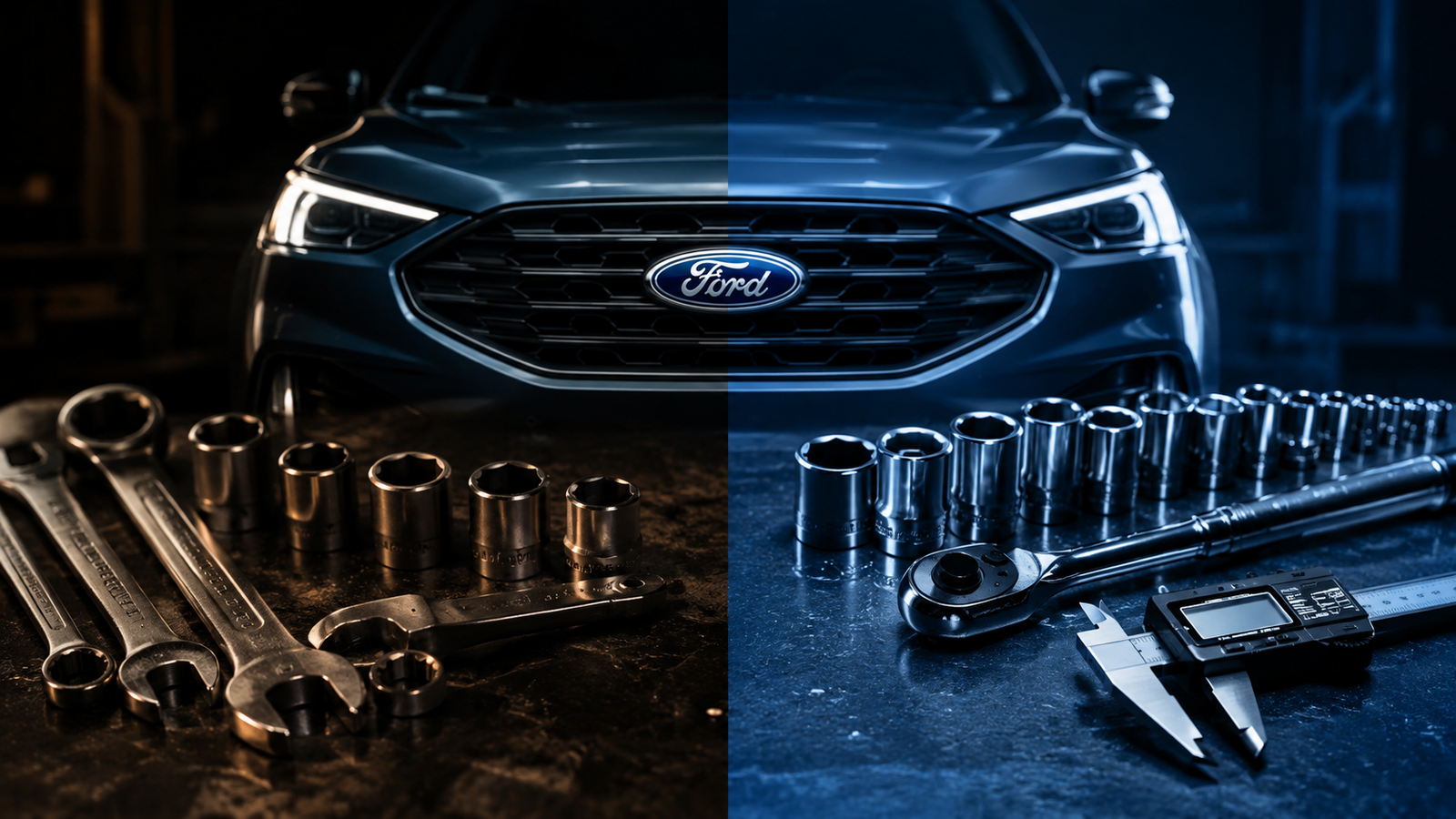
For most Ford owners working on vehicles from the 1990s or later, a solid metric socket and wrench set covering sizes from about 8mm to 19mm will handle the vast majority of repairs. Common sizes you will use frequently include 10mm, 12mm, 13mm, and 14mm, since these show up repeatedly across engine covers, brackets, and interior panels.
If you are maintaining an older classic Ford, you will want a complete SAE set instead, typically ranging from 3/8 inch up to 3/4 inch for most fasteners, along with a set of standard Allen keys for smaller components.
For anyone working across multiple Ford generations, such as a mechanic or a hobbyist who owns both a classic Mustang and a modern F-150, it makes sense to invest in a combination set that includes both standard and metric sockets, wrenches, and hex keys. Reputable toolmakers known for durable automotive sets include brands widely used in professional shops, and a mid-range combination set is usually more than sufficient for home garage work.
How to Tell If a Bolt Is Metric or Standard
If you are ever unsure which system a specific bolt belongs to, there are a few reliable ways to check.
The simplest method is visual and physical testing. Try a metric socket on the bolt head first, since most Fords built after 1990 are metric. If the socket fits snugly without any wobble, you have your answer. If it feels loose or rounds slightly, switch to the closest standard size and test again.
A bolt or thread gauge, available inexpensively at most hardware stores, gives you an exact reading of both the diameter and thread pitch, which removes any guesswork entirely. This is especially useful when reassembling a part where matching the original fastener is critical for safety, such as suspension or brake components.
Finally, thread pitch itself is a giveaway. Metric bolts are measured in millimeters and have a specific distance between threads, while standard bolts are measured in threads per inch. If you already know a bolt’s diameter but are unsure of the system, counting the threads over a one-inch span and comparing it to a reference chart can confirm which system you are dealing with.
Common Mistakes When Working on Fords
One of the most frequent errors home mechanics make is assuming an entire vehicle uses only one measurement system, especially with transition-era models from the late 1970s and 1980s. Grabbing a metric socket for what is actually a standard bolt, or vice versa, often results in a socket that appears to fit but is actually slightly off, which can round the bolt head or strip the threads.
Cross-threading is another common issue, particularly when reinstalling parts. If a bolt does not thread in smoothly by hand, it is almost always the wrong size or the wrong system entirely, and forcing it will damage both the bolt and the threaded hole.
Finally, many people damage delicate hardware simply because they force a wrench that is close in size but not exact. A metric 13mm socket, for example, is very close in size to a standard 1/2 inch socket, and using the wrong one under torque can round off the corners of the bolt head, making removal significantly harder down the line.
Frequently Asked Questions
Does Ford use metric or standard bolts today? Modern Ford vehicles, generally those built from the 1990s onward, use metric bolts and fasteners throughout the vast majority of the engine, chassis, and body.
Are Ford F-150 trucks metric? Yes, F-150 trucks from recent generations are built predominantly with metric fasteners, though some interior trim screws may still be standard sizing.
What size wrench set do I need for a Ford? For most modern Fords, a metric set ranging from 8mm to 19mm will cover the majority of repairs, with 10mm, 12mm, 13mm, and 14mm being the most frequently used sizes.
Do old Mustangs use standard tools? Yes, classic Mustangs built before the mid-1970s use standard SAE fasteners almost exclusively, so a full imperial toolset is necessary for restoration work.
Are Ford lug nuts metric? On virtually all modern Ford models, lug nuts are metric sized, typically requiring a 19mm or 21mm socket depending on the specific model and wheel setup.
Conclusion
So, does Ford use standard or metric hardware? The clearest takeaway is that it depends heavily on the age of the vehicle. Classic Fords built before the mid-1970s rely on standard imperial fasteners, transition-era models from the late 1970s through the 1980s often use a mix of both systems, and virtually every Ford produced from the 1990s to today is built predominantly with metric hardware.
For most everyday Ford owners working on modern vehicles, a quality metric socket and wrench set will handle almost every job you encounter. If you own or work on older classics, keep a standard set on hand as well, and if you regularly move between eras, a combination toolkit is your best investment.
Before your next repair, it is worth printing or bookmarking the tables in this guide as a quick-reference cheat sheet, so you always grab the right tool on the first try.
Related Articles
How Much Is a 1953 Ford Jubilee Tractor Worth?
What Is a Ford FE Motor? Complete Guide to History, Specs & Variants
What Does the F Stand for in F150?
Does the Ford Edge Have a 3rd Row? Full Seating Guide (2026)
How Long Do Ford Fusions Last? Complete Mileage and Longevity Guide