
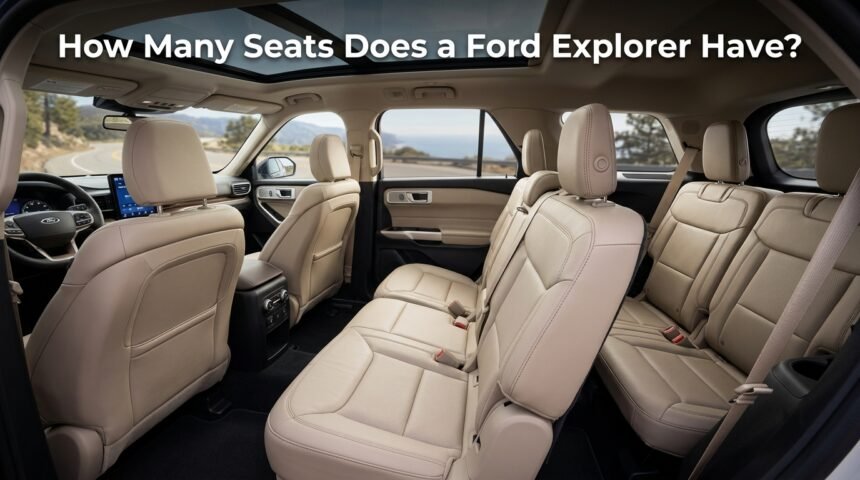
If you’re shopping for a three-row family SUV, one of the very first questions you’ll want answered is simple: how many seats in a Ford Explorer can you actually get? The short answer is that the Explorer seats either six or seven people, depending on how the second row is set up. But that one-line answer only scratches the surface of what matters when you’re trying to figure out whether this SUV will comfortably fit your family, your carpool, or your weekend road-trip crew.
This guide walks through everything connected to Ford Explorer seating — the two available layouts, how much room each row really offers, how seating differs across trim levels, and how the Explorer stacks up against other three-row SUVs on the market. By the end, you’ll have a clear picture of which configuration makes the most sense for the way you actually use your vehicle.
2. Ford Explorer Seating Capacity at a Glance
Every Ford Explorer comes with three rows of seating standard — there’s no two-row version to worry about. What changes from trim to trim is the second row, and that’s what determines your total headcount.
There are two configurations to know:
- 7-passenger layout: The second row uses a bench seat, which adds one extra seating position compared to captain’s chairs. This is the configuration to look for if you regularly need to carry a full house.
- 6-passenger layout: The second row swaps the bench for two individual captain’s chairs with a walk-through aisle between them. You lose one seat, but you gain easier access to the third row and a more comfortable, separated seating feel for second-row passengers.
Here’s a simple snapshot of how that plays out:
| Configuration | Second Row | Total Seats | Best For |
|---|---|---|---|
| 7-Passenger | Bench seat | 7 | Larger families, carpools, maximum headcount |
| 6-Passenger | Captain’s chairs | 6 | Comfort, easier third-row access, fewer regular passengers |
Both layouts include a functional third row on every trim, so no matter which version you choose, you’re never limited to just two rows of seating.
3. Row-by-Row Breakdown
3.1 First Row (Front Seats)
The front row is where the driver and front passenger sit, and it’s consistent across every trim and every seating configuration — this row doesn’t change based on whether you pick the 6- or 7-seat layout. Front-seat comfort features vary by trim, but the space itself is generous, with roughly 42 to 43 inches of legroom depending on the trim you choose. This is the one row where you won’t need to make any seating trade-offs.
3.2 Second Row
This is the row that decides your total passenger count, and it’s worth thinking through carefully.
The bench seat version stretches across the full width of the cabin and holds three people side by side, bringing total capacity to seven. It’s the practical choice if you regularly need every seat filled — think large families, frequent carpool duty, or road trips with extended family along for the ride.
The captain’s chairs version replaces that bench with two separate, more heavily bolstered seats and a center walk-through space. This drops your second-row capacity to two people (six total), but it makes climbing into the third row noticeably easier, since passengers can step through the gap instead of climbing over a folded seatback. Second-row legroom sits around 37 inches, which is comfortable for most adults on all but the longest trips.
3.3 Third Row
Every Explorer, regardless of trim, includes a working third row — this isn’t an add-on or a rare option. Third-row seating fits two or three passengers depending on the configuration, though realistically it’s best suited to children, teenagers, or adults on shorter drives.
Third-row legroom comes in at roughly 32 inches, which is tight compared to the front two rows but in line with what you’d expect from this class of SUV. If third-row comfort for adults is a top priority, look for trims that offer power-folding third-row seats, since they make loading and unloading passengers and cargo much easier.
4. Seating Configurations by Trim Level
Seating availability isn’t identical across the Explorer lineup — it varies by trim, so it pays to check before you buy. Generally speaking:
- Entry and mid-level trims tend to offer captain’s chairs standard, with a bench seat available as an option to bump capacity up to seven.
- Upper trims often lean toward the six-passenger captain’s-chair layout as their standard setup, prioritizing comfort and third-row access over maximum headcount.
- Performance-oriented trims frequently come with captain’s chairs only, since the six-passenger layout fits the sportier, driver-focused personality of those models.
- Off-road-focused trims may have more limited seating configuration choices, so it’s worth confirming exact availability with a dealer.
Because these details shift from year to year and trim to trim, the most reliable way to confirm exact seating for a specific Explorer is to check the build-and-price tool for the current model year or ask your dealer directly which second-row option comes standard versus optional on the trim you’re considering.
5. Interior Space & Comfort Metrics
Numbers tell the real story when it comes to comfort, especially for taller passengers or families who’ll be using all three rows regularly. Here’s how the cabin space typically breaks down across the Explorer’s three rows:
| Measurement | First Row | Second Row | Third Row |
|---|---|---|---|
| Headroom | ~40.7 in | ~40.5 in | ~38.9 in |
| Legroom | ~42.9–43 in | ~37–37.5 in | ~31.8 in |
| Shoulder Room | ~62 in | ~62 in | ~54.6 in |
| Hip Room | ~59 in | ~59 in | ~41 in |
Total passenger volume across the cabin typically lands somewhere between roughly 144 and 153 cubic feet depending on trim and seating choice — a solid figure for the three-row SUV segment. As a general rule, the front two rows offer genuinely adult-friendly space, while the third row is best treated as bonus seating for kids, shorter trips, or occasional extra passengers.
6. Cargo Space vs. Seating Trade-offs
Seating and cargo space are directly connected in any three-row SUV, and the Explorer is no exception. The more rows you have upright, the less room you have for gear.
- All three rows in use: You still get a respectable amount of cargo space behind the third row — enough for grocery runs, backpacks, and everyday errands.
- Third row folded flat: Cargo space expands significantly, opening up room for larger items like strollers, sports equipment, or luggage for a family trip.
- Second and third rows folded: This unlocks maximum cargo capacity, turning the Explorer into a genuine hauler for furniture, home projects, or big grocery and warehouse-store runs.
Many trims offer power-folding third-row seats, which fold flat at the touch of a button rather than requiring you to manually wrestle with seatbacks and levers. If you frequently switch between carrying passengers and carrying cargo, this feature is worth prioritizing when you’re comparing trims.
7. Family & Passenger Use Cases
Not every buyer needs the same seating setup, so it helps to think about how you actually use your SUV day to day.
Families with young children often lean toward captain’s chairs. The walk-through aisle makes it far easier to buckle a car seat or help a toddler climb in and out, and the separated seats reduce sibling squabbles on long drives.
Carpool and rideshare use generally favors the bench seat and its extra seventh position, since fitting one more passenger can be the difference between two trips and one.
Road trips with adults tend to work best with captain’s chairs, since the improved third-row access and slightly more personal space in row two make longer drives more comfortable for everyone.
Car seat compatibility is worth double-checking regardless of which layout you choose — LATCH anchor points are positioned in the outboard second-row seats in both configurations, so most car seats will install securely either way, but it’s always smart to test-fit your specific seat before you buy.
8. Comparison: 6-Seat vs. 7-Seat Configuration
| Factor | 6-Seat (Captain’s Chairs) | 7-Seat (Bench) |
|---|---|---|
| Total Capacity | 6 | 7 |
| Third-Row Access | Easier (walk-through aisle) | Slightly harder (climb over) |
| Second-Row Comfort | More individual space | More communal, less separation |
| Best For | Comfort-focused families, couples with occasional extra passengers | Larger households, frequent carpooling |
| Pricing | Often bundled into higher trims | Often standard or a low-cost option on base/mid trims |
Neither layout is objectively “better” — it comes down to whether you value maximum seating capacity or maximum comfort and ease of movement within the cabin.
9. How Ford Explorer Seating Compares to Competitors
The three-row midsize SUV segment is crowded, and seating flexibility is one of the main ways these vehicles differentiate themselves.
- Toyota Highlander: Seats up to eight with a second-row bench, or seven with captain’s chairs — slightly higher max capacity than the Explorer in its bench configuration.
- Honda Pilot: Typically offers seating for seven or eight depending on trim, with a spacious third row that’s often praised for adult comfort.
- Chevrolet Traverse: Known for one of the largest cabins in the class, often seating up to eight passengers.
- Hyundai Palisade: Offers both seven- and eight-passenger configurations, with a reputation for a well-finished, comfortable third row.
Compared to these rivals, the Explorer’s maximum of seven is slightly lower than some competitors that can reach eight passengers with a front bench or three-across second-row bench. Where the Explorer tends to hold its own is in the flexibility and comfort of its captain’s-chair option, plus its balance of on-road driving feel with three-row practicality.
10. Model Year Changes in Seating
Seating configurations and standard equipment on the Explorer have shifted somewhat across recent model years, with certain trims moving between six- and seven-passenger standard setups and captain’s chairs becoming more widely available across the lineup. If seating capacity is a deciding factor in your purchase, it’s worth comparing configuration details for the specific model year you’re shopping, since standard and optional seating can change from one year to the next.
11. Frequently Asked Questions
Does the Ford Explorer seat 8 people?
No. The maximum seating capacity on the Explorer is seven passengers with the second-row bench seat. It does not offer an eight-passenger configuration.
Can adults sit comfortably in the third row?
Adults can fit in the third row, but with roughly 32 inches of legroom, it’s better suited to shorter trips. For daily comfort, the third row works best for kids and teens.
Is the third row worth it?
For most three-row SUV buyers, yes — even if it’s used only occasionally, having a working third row adds flexibility for school pickups, extra passengers, or family gatherings that a two-row SUV simply can’t offer.
Which trims come standard with 7 seats?
This varies by model year and trim, with the bench seat more commonly standard or available on entry and mid-level trims. Always confirm current availability with a dealer or the manufacturer’s build tool.
Can you upgrade from 6 to 7 seats?
In most cases, the second-row seat type is selected at the time of purchase as part of the trim or an options package, rather than something you swap afterward. If maximizing seat count matters to you, choose the bench-seat configuration when you order or buy.
12. Conclusion
So, how many seats in a Ford Explorer can you expect? The answer comes down to two solid options: a 7-passenger layout with a second-row bench for maximum headcount, or a 6-passenger layout with second-row captain’s chairs for extra comfort and easier third-row access. Every trim includes a genuinely usable three-row layout, so the real decision isn’t whether you’ll have enough rows — it’s which second-row style fits how your family actually rides.
If maximum capacity is the priority, lean toward the bench-seat configuration. If comfort and ease of movement matter more, the captain’s-chair layout is likely the better fit. Either way, it’s worth comparing trims side by side, checking current-year seating availability, and, if possible, sitting in both layouts in person before you decide.
Related Articles
What Does Ford OBS Stand For? The Complete Guide to Old Body Style Trucks
What Is a Ford FE Motor? Complete Guide to History, Specs & Variants
Is a 1000A Jump Starter Good for a 2007 Ford Escape? Full Guide